
In the tapestry of automotive artistry, the Jaguar F-Type emerges as a captivating enigma, weaving threads of British luxury and raw power since its 2014 debut. As we reflect in 2025, this two-door sports car, once Jaguar's more accessible offering, now rests in the annals of history—a symbol of beauty that danced with flaws. Its sleek silhouette, like a predator poised in moonlight, promised exhilaration yet concealed challenges that echoed through the years. For enthusiasts, it was a dream wrapped in reality, where the roar of engines mingled with whispers of compromise. Today, with Jaguar's shift toward an electric future, the F-Type stands as a nostalgic relic, its legacy etched not just in speed but in the stories of those who dared to embrace its contradictions. 🏁💨
The Thrill and Tribulations of Performance
At the heart of the Jaguar F-Type lay a beast of power—a 5-liter V8 DOHC engine that unleashed 495 horsepower and 460 lb-ft of torque, propelling the car from 0 to 60 mph in a mere 3.9 seconds. Such ferocity painted the skies with adrenaline, a symphony of acceleration that thrilled the soul. Yet, this performance came with shadows. Early models, like the 2014 variant, featured rear-wheel drive, making them tail-heavy and unruly on the road—a wild stallion that bucked under pressure. Jaguar sought to mend this with all-wheel drive in later editions, adding stability but birthing new woes: tires wept under excessive force, wearing out prematurely, and the suspension, taut as a drawn bow, transformed rides into jarring ordeals. Though the automaker enhanced power over time, the quest for perfection often stumbled. 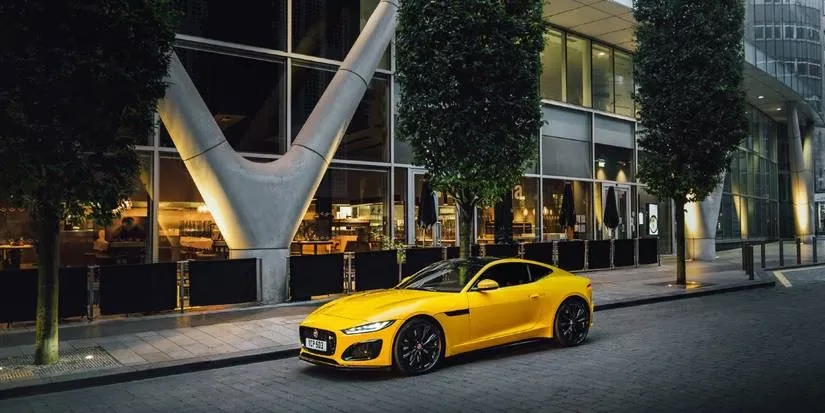 In the dance of control, many found the F-Type a demanding partner, its eight-speed automatic transmission a seamless guide but not always a gentle one. 😕⚙️
The Confines of Luxury
Step inside the Jaguar F-Type, and one encountered a paradox—a cabin that whispered opulence yet screamed confinement. Designed for elegance, the interior proved too snug, especially for those with broader frames, turning comfort into a distant memory. Storage space? A mere afterthought, with cargo areas laughably sparse, forcing owners to pare down life's essentials. Creature comforts and modern technology were glaring omissions; early models felt like relics, lacking the infotainment and amenities expected in a luxury sports car. While rivals embraced innovation, the F-Type's interior seemed hastily assembled, a jigsaw puzzle where pieces clashed rather than connected. 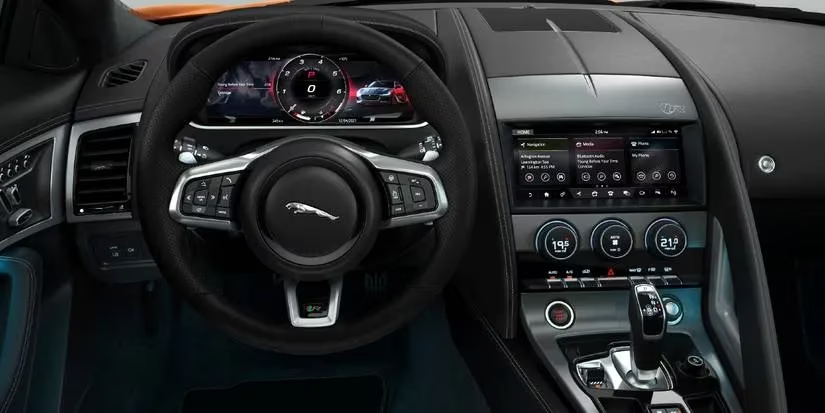 This wasn't just a minor quibble—it was a cavern of disappointment, where the promise of Jaguar's prestige faded into the reality of cramped quarters. For many, the experience felt like wearing a crown that pinched, a reminder that beauty often demands sacrifice. 😔🛋️
The Shifting Gears of Choice
Manual transmission—a purist's delight—became a fleeting chapter in the F-Type's saga. Initially absent, customer clamor birthed a three-pedal option, only for Jaguar to snatch it away with the 2020 model. This shift mirrored the car's identity crisis: faster, yes, but stripped of soulful control. Enthusiasts mourned the loss, as the automated gears, though efficient, lacked the tactile joy of human mastery. The evolution spoke volumes—progress at the cost of passion, leaving a void in the driving experience. 🚗💔
The Price of Elegance
Despite its billing as Jaguar's budget-friendly entry, the F-Type commanded a princely sum, with fully decked-out versions soaring past $100,000. This placed it in a curious limbo—too expensive for casual admirers, yet not quite rivaling the pinnacle of luxury sports cars. The cost, a heavy anchor, deterred many, as expectations of excellence clashed with the reality of compromises. In 2025, as inflation reshapes markets, this price point feels even steeper, a testament to how exclusivity often walks hand-in-hand with exclusion. 💸🔍
Legacy in 2025: A Flawed Masterpiece
As Jaguar pivots toward electric horizons, the F-Type's journey concludes, its final edition—the F-Type 75—a bittersweet farewell. Today, it stands not just as a car, but as a cultural icon, its common problems woven into its charm. Reflecting on ownership, key concerns persist:
-
Handling Hurdles: Early rear-wheel drive models were unstable; later all-wheel drive versions suffered from rapid tire wear and stiff suspension.
-
Interior Intricacies: Cramped space, minimal storage, and outdated tech plagued comfort.
-
Transition Troubles: The on-again, off-again manual option highlighted inconsistency.
-
Cost Conundrums: High price tags blurred its value proposition.
A comparison of models reveals the evolution:
| Year | Engine | 0-60 mph Time | Drive Type | Notable Issues |
|---|---|---|---|---|
| 2014 | 5.0L V8 S | 3.9 seconds | RWD | Tail-heavy handling |
| 2020 | Enhanced V8 | Under 4 sec | AWD | Tire wear, no manual option |
In the end, the Jaguar F-Type was a riddle—a vehicle that dazzled with style and speed, yet faltered in finesse. Its imperfections, like cracks in marble, only deepened its allure, reminding us that true elegance lies not in flawlessness, but in the courage to embrace the imperfect. As the sun sets on this chapter, the F-Type whispers a timeless truth: in the race for greatness, it's the journey, not the finish line, that defines the legend. 🌅✨