
In a world obsessed with the latest and greatest, where tech specs are king and planned obsolescence is the norm, there exists a mechanical relic that simply refuses to die. We're talking about an engine that debuted in an era of grunge music and dial-up internet, yet is still rolling off assembly lines and powering new vehicles in 2026. How is this even possible? In an age of turbocharged hybrids and autonomous driving, what could possibly keep a 35-year-old diesel engine relevant? The answer isn't found in cutting-edge innovation, but in something far more profound: unwavering, no-nonsense reliability.
The Birth of a Legend: Built for Survival, Not Speed
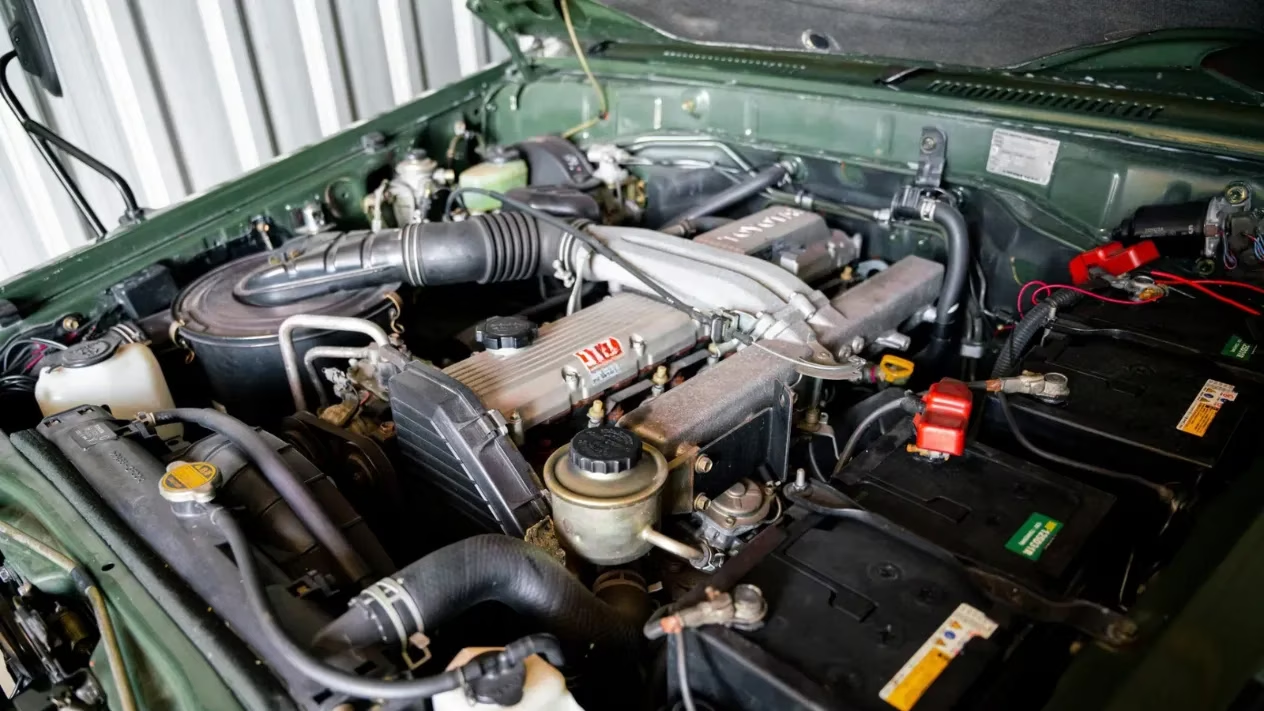
Let's rewind the clock. Back in 1990, Toyota engineers weren't chasing horsepower records or designing for magazine covers. Their mission was brutally simple: create an engine that could survive the planet's most unforgiving environments. Enter the Toyota 1HZ. This 4.2-liter inline-six diesel was born to serve one master—the legendary Land Cruiser 70 Series. Its design philosophy was the antithesis of modern engineering: no turbocharger, no direct injection, no complex electronics. Just pure, unadulterated mechanical simplicity.
What's under the hood? Let's break it down:
-
Heart of Iron: A heavy-duty cast-iron block and head for ultimate durability.
-
Strong Bones: A forged crankshaft that laughs at stress.
-
Timing You Can Trust: Gear-driven timing—no rubber belts to snap, no chains to stretch.
-
Brain of a Hammer: A mechanical fuel pump so tolerant it can run on questionable diesel fuel found in the most remote corners of the globe.
With about 129 horsepower and 210 lb-ft of torque, it won't win any drag races. But ask it to climb a mountain, ford a river, or haul a ton of supplies across a desert, and it just says, "Yes." This engine wasn't built to be cool; it was built to work. And in 2026, that's exactly what it's still doing.
Global Trust: The Engine That Powers the World's Toughest Jobs
So, where do you find this dinosaur in 2026? You won't see it in a shiny city crossover. The 1HZ lives where failure is not an option. It's the heartbeat of vehicles trusted by those who operate beyond the edge of civilization.
Who still relies on the 1HZ?
| Organization/User | Use Case | Reason for Trust |
|---|---|---|
| Humanitarian Agencies (UN, Red Cross, Doctors Without Borders) | Delivering aid in conflict zones and remote areas. | Simplicity = reliability. No laptops needed for repairs. |
| Military Forces | Troop transport and logistics in extreme conditions. | Proven durability and easy field maintenance. |
| Farmers & Ranchers (Especially in Australia) | Daily farm work, mustering cattle, hauling water. | Can run for hundreds of thousands of miles with basic care. |
| Mining Operations | Underground and remote site support vehicles. | Can idle for hours and withstand brutal dust and heat. |
Through Toyota Gibraltar Stockholdings (TGS), these organizations specifically order new Land Cruiser 70 Series vehicles—like the HZJ76 wagon, HZJ78 Troop Carrier, and HZJ79 pickup—with the 1HZ engine. Why? Because when you're in the Australian Outback, the African Savanna, or the Middle Eastern desert, your life might depend on an engine that just. won't. quit. The 1HZ’s global parts network means a mechanic in Namibia or Western Australia can likely find what they need in a roadside shed. Try that with a modern twin-turbo V6! 🤔
Engineering for Eternity: Why the 1HZ Simply Can't Die
The 1HZ's longevity isn't an accident; it's a masterclass in deliberate, purpose-built engineering. While other engines have undergone complete redesigns every few years, the 1HZ's core architecture has remained virtually unchanged for over three decades. The few updates it has received—like adding an EGR valve and electronic fuel control in the early 2000s—were only to meet emissions standards, not because the original design was flawed.
What makes it so indestructible?
-
Simplicity is King: No turbo means no turbocharger failure or heat stress. No high-pressure common-rail injection means no $5,000 injector failures.
-
Mechanical Over Electronic: The mechanical fuel pump is the star. It doesn't need an ECU, doesn't throw cryptic error codes, and can be fixed with basic tools.
-
Overbuilt, Not Overthought: Every component, from the block to the crankshaft, was built with a massive safety margin. It's like a tank in engine form.
Owners' stories are legendary. On forums and subreddits, it's common to see odometers reading 500,000, 600,000, even 800,000 kilometers on the original 1HZ. One owner famously stated their rig was still running strong at over 1 million kilometers with just basic maintenance. These aren't garage queens; these are engines that have spent their lives being punished, and they just ask for oil changes in return.
Not Alone, But The Patriarch: Other Endurance Legends
The 1HZ isn't the only engine with an ironclad resume. It stands as the patriarch among a small group of mechanical legends that have defied time.
-
Toyota 1GR-FE: This 4.0L V6 gasoline engine debuted in 2002 and is still powering new Toyota 4Runners, Tacomas, and Land Cruiser Prados in 2026. Praised for its bulletproof timing chain and robust cooling system, it proves Toyota's reliability magic works with gas engines too.
-
Mercedes-Benz OM617: This 3.0L inline-five turbo diesel from the 1970s and 80s is the European counterpart to the 1HZ. Found in iconic models like the W123, it's famous for its overbuilt internals and mechanical fuel injection. You can still find these engines running strong today, decades after production ended.
What do all these engines share? A philosophy that seems almost radical today: build it right, build it strong, and don't fix what isn't broken.
The Last of Its Kind: A Legacy That Rolls On
As we look at the automotive landscape in 2026—dominated by electrification, downsizing, and software-defined vehicles—the continued production of the Toyota 1HZ feels like a beautiful anachronism. It's a living testament to a different set of values.
Toyota's commitment to keeping the 1HZ and the 70 Series platform alive worldwide is a statement. It says that for a significant portion of the planet, capability and reliability trump comfort and technology. The 1HZ wasn't made to impress journalists on a test track; it was made to save lives in a drought, deliver supplies after an earthquake, and help a farmer feed his family.
So, is the Toyota 1HZ the "best" engine? By modern metrics of power, efficiency, or emissions, absolutely not. But is it one of the most important engines ever built? Without a doubt. It represents the pinnacle of a specific, fading art: the art of building machines that serve humanity in the harshest conditions, with a stubborn, glorious refusal to fail. In 2026, while the world races toward an electric, automated future, the deep, steady thrum of the 1HZ diesel is still out there—a reassuring reminder that sometimes, the ultimate innovation is just showing up, every single day, for 35 years and counting. 🛠️💨