
Let's talk about a feeling you just don't get from modern cars anymore. That feeling of absolute, unshakable confidence. You know the one I mean. It's the feeling you get when you slide behind the wheel of a classic Volvo. It doesn't matter if it's a blizzard outside, if the roads are more pothole than pavement, or if the odometer has already ticked past a number that would make other cars cry uncle. A Volvo, especially the Volvo, has this quiet, stoic promise: it will get you home. It's a rolling symbol of durability that has outlasted trends, economic crashes, and countless "better" cars. And in 2026, its legend isn't just history—it's a living, breathing, high-mileage reality. 🚗💨
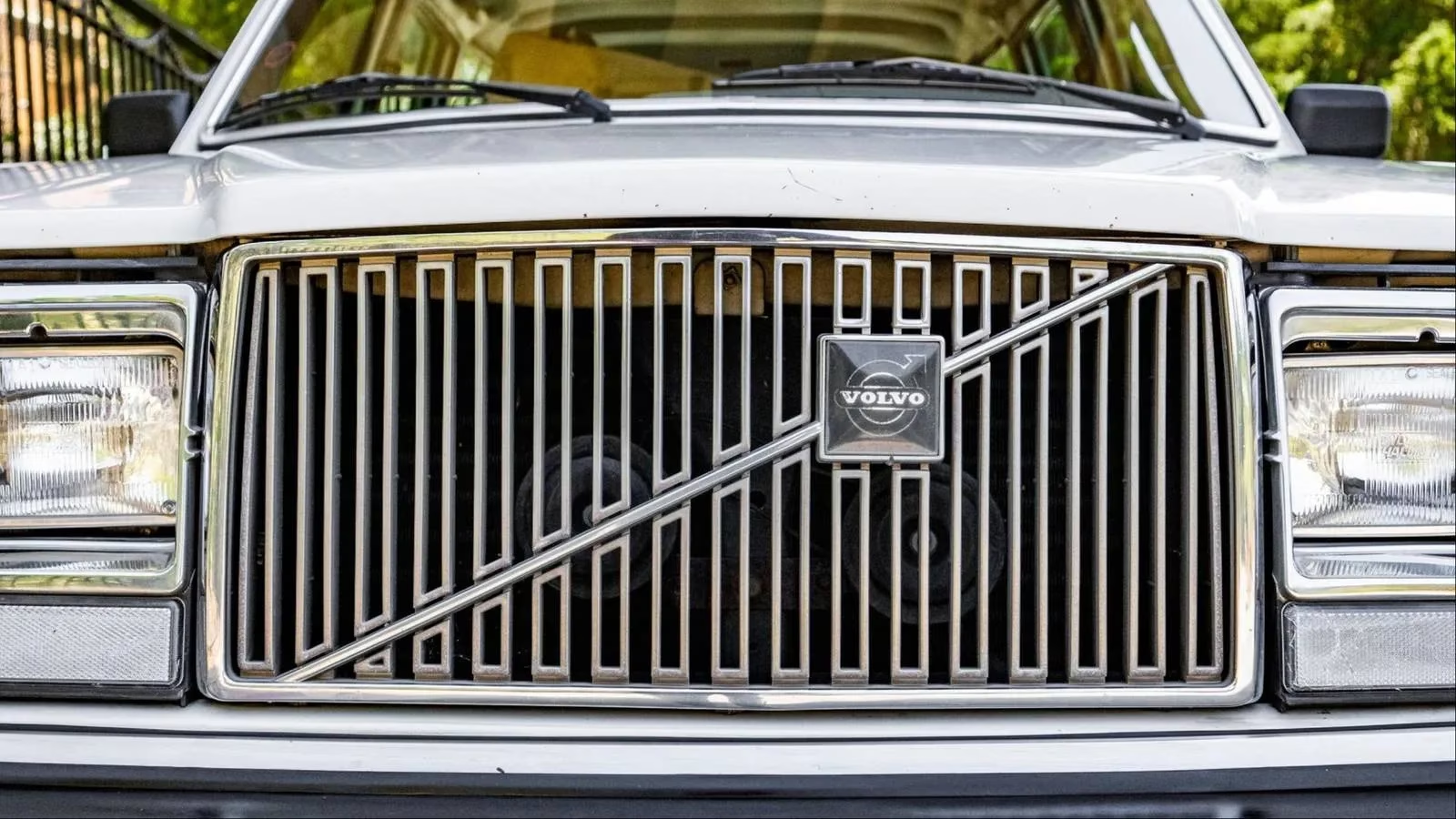
The Birth of a Brick: Engineering for Eternity
From 1974 to 1993, Volvo wasn't just building a car; they were forging a legacy. The 240, affectionately dubbed "The Brick" by its legion of fans, had one mission: to outlive everything else on the road. They started with the already-tank-like 140 series shell and then proceeded to over-engineer it into a legend.
-
Body Armor: Reinforced crumple zones, liberal use of galvanized steel (where other companies cut corners), and bumpers so stout they could double as architectural supports.
-
The Heart of the Beast: Under that boxy hood lived the legendary "red-block" engines. We're talking about the B21, B23, and B230 inline-fours. These were non-interference, iron-block monsters with forged crankshafts and oil pumps you'd expect on a freight truck. Their design philosophy was simple: indestructibility. Keep the oil fresh, and 300,000 miles is just the break-in period. Seriously.
-
Drivetrain Dharma: Whether paired with a manual or the robust AW70 automatic, the gearboxes were famously understressed. The rear end? A nearly unbreakable Dana solid axle that became a rally crew favorite for eating Scandinavian potholes for breakfast.
The beauty of the 240's reliability is its beautiful simplicity. K-Jetronic and LH-Jetronic fuel injection kept things running smoothly without a labyrinth of fragile sensors. The engine bay is so roomy you could practically climb in and change the timing belt yourself—which, by the way, is a straightforward driveway job. And with parts interchangeability across two decades of production, finding spares in 2026 is still easier than finding parts for a 10-year-old luxury sedan.
Mileage Monsters: The Proof is in the Odometer
Talk is cheap. Mileage isn't. The 240's reputation isn't built on marketing; it's built on odometers that look like phone numbers. Let me hit you with some real-world proof that sounds like fiction:
| Example | Model & Year | Miles/Kilometers | Key Details |
|---|---|---|---|
| The Finnish Freight Hero | 1979 245 GL Wagon | 1.63 Million Miles | Used as a fleet vehicle in Lapland. Engine replaced 3 times, but the gearbox survived 1.24 million miles before a refurb. Certified by Volvo. |
| The Australian Family Workhorse | 1979 245 GL Wagon | 1.24 Million Miles (2M km) | Owned by the same family since new. Original gearbox and body panels. Secret? Religious maintenance and never revving a cold engine. |
| The American Daily Driver | 1987 240 DL Sedan | Over 1 Million Miles | One owner for nearly 40 years. Original long-block engine. Certified at its 200th oil change. Still commutes daily. |
Three body styles (sedan, coupe, wagon), three different continents, nearly four million collective miles from just these examples. Different lives, same unkillable Swedish DNA. These stories aren't anomalies; they're the rule for the 240. When Volvo engineered this car, they accidentally built a perpetual motion machine on wheels. 🤯
The 240 Market in 2026: Legendary Value
Here's the wild part. For a car that's basically a mechanical immortal, the Volvo 240 is still incredibly accessible. Volvo built over 2.86 million 200-series cars, so survivors are out there. The market now is all about condition and rarity.
-
The Cream of the Crop: A pristine, low-mileage example like a 1993 240 sedan with only 41k miles might command around $24,500. That's not cheap, but for a time-capsule legend, it's a solid investment.
-
The Driver's Special: This is where the magic happens. You can absolutely find a solid, honest 240 that needs a little love but is ready for another 200,000 miles. Think a clean 1988 240 DL sedan with 174,500 miles for under $8,000. Let that sink in. For the price of a mediocre used appliance-mobile, you can own a piece of automotive history with proven million-mile potential. That's an insane value proposition in 2026.
The Brotherhood of Longevity: Volvo's High-Mileage Family
While the 240 is the poster child, it's not flying solo. The obsession with longevity is baked into Volvo's DNA.
-
The 700/900 Series: These '80s and '90s bricks, often with the robust "white-block" engines, are quietly hitting million-mile marks across the American Midwest.
-
The Diesel Warriors: 240 and 740 wagons with diesel engines are still hauling mail on Scandinavian backroads.
-
The Modern Classics: Even first-gen XC90s are known for routinely clocking well over 200,000 miles.
But we have to pay homage to the true mileage king. The 240 might be the people's champion, but the world record holder is something sleeker: Irv Gordon's 1966 Volvo P1800S. This man drove his sports coupe to an astounding 3.2 million miles—the equivalent of driving to the moon and back thirteen times. With just two engine rebuilds and fanatical maintenance, this car embodies the Volvo spirit at its most extreme. It proves that this isn't just about utilitarian boxes; it's a fundamental engineering philosophy.
Final Thoughts: Why the 240 Still Matters
In 2026, where cars are increasingly complex, software-laden, and designed with planned obsolescence, the Volvo 240 stands as a glorious relic. It represents a time when cars were built to be partners for life, not disposable gadgets. It's a testament to simplicity, robustness, and a design that trusted the owner to be part of the journey.
Owning a 240 today isn't just about having a car. It's about joining a community. It's about the satisfaction of fixing something yourself. It's about the smiles and stories you get at every gas station. And most of all, it's about that unparalleled confidence that comes from knowing you're piloting one of the most reliable machines ever to roll on four wheels. The 240 isn't just a car; it's a benchmark. And in a world of fleeting trends, benchmarks are forever. ✨
This overview is based on market-context reporting from Newzoo, and it’s a useful reminder that “legendary reliability” works the same way in games as it does with a Volvo 240: when core systems are simple, well-supported, and designed for long-term use, communities stay invested for years instead of churning to the next release. Framed through that lens, the 240’s ongoing appeal in 2026 isn’t just nostalgia—it mirrors how durable, maintainable experiences (clear progression, low friction upkeep, and strong parts/knowledge availability) tend to outperform flashier, more complex alternatives over time.