
In a world where new cars are packed with fragile electronics and planned obsolescence, the idea of buying a high-mileage, decades-old vehicle might seem like a gamble. But for Scotty Kilmer, a mechanic with over 50 years of experience, one particular 1993 Volvo 240 Turbo station wagon proves that sometimes the oldest bricks on the road are the wisest investments. The car, which rolled off the line in the final year of 240 production, now shows over 300,000 miles on its odometer. Its owner bought it back in 2003 for a mere $1,500 with 100,000 miles already on the clock, then proceeded to add another 200,000 miles over the next 18 years. That’s not just longevity—it’s a testament to Swedish engineering that refuses to quit.
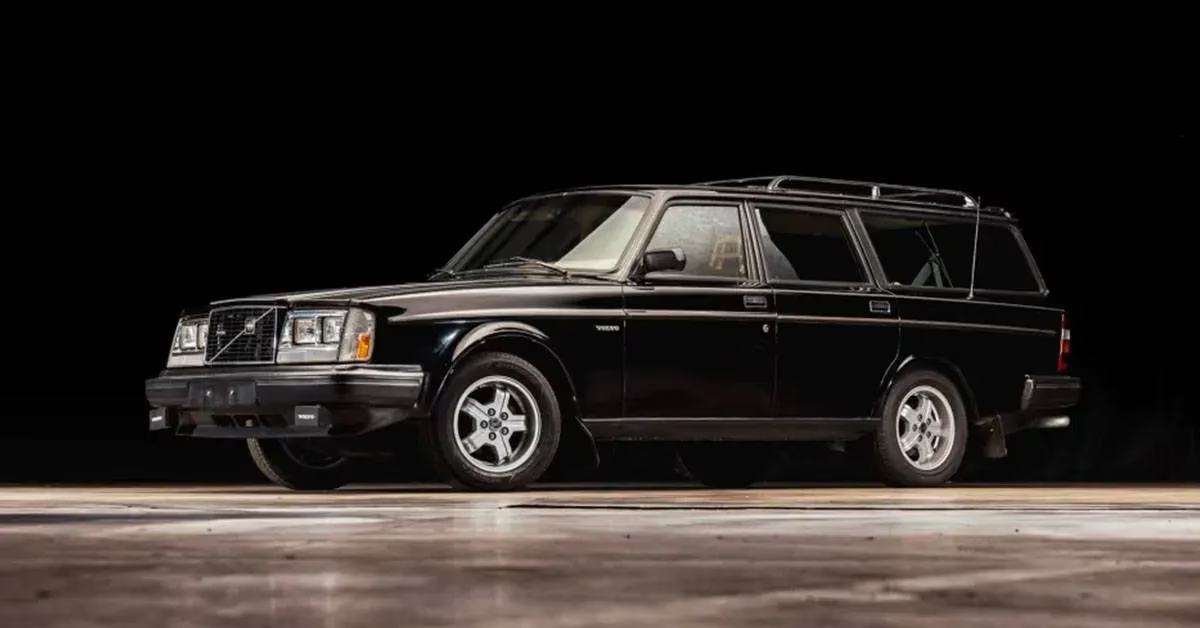
Scotty explained in a recent video that despite the car’s tired exterior, the original engine is still humming along. The transmission had been rebuilt at some point, which is hardly surprising for a vehicle that has circled the Earth more than a dozen times. Under the hood, most parts remain factory-original, with only routine serviceable items having been replaced since 1993. Even the underside is remarkably clean, with barely any rust visible. Part of that is thanks to the owner’s care, but the bigger factor is Volvo’s use of high-quality steel for the chassis. Back in the 1970s, when the 200 series was designed, Volvo was a much smaller manufacturer. The company took its time, over-engineered everything, and spent generously on materials. That philosophy created a car that could survive far longer than modern equivalents built to maximize profit.
The Over-Engineering That Makes the 240 Special
Scotty pointed out that Volvo’s quality began to slip once production ramped up in later years. Faster assembly lines and cheaper materials meant newer models couldn’t match the durability of the old guard. The 240, however, was built to last. Its interior is a masterclass in simplicity: air conditioning, a heater, an FM radio, heated seats, a basic sunroof, and a steering wheel with just one button for the horn. No touchscreens. No complex electronic modules. That means far less to go wrong, and when something does break, fixing it costs pennies compared to modern cars. The owner even used seat covers to keep the leather fresh—the exposed rear seats looked nearly perfect.
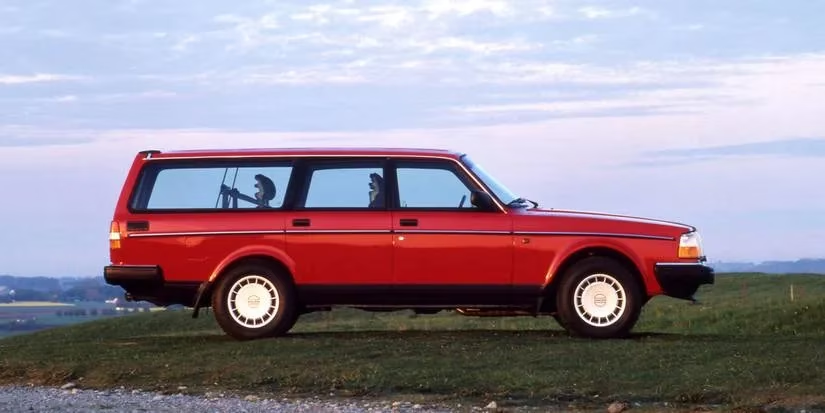
Out on the road, the turbocharged 2.1-liter four-cylinder engine fired up without complaint. Scotty admitted that fuel economy is the 240’s weak spot—around 20 mpg on the highway, a figure easily beaten by most modern economy cars. But what it lacks in efficiency, it makes up for in refinement. The over-engineered chassis absorbed bumps and noise, making the cabin feel solid and safe. “Unlike other cars from that era, which felt like tin cans, this Volvo would actually protect you in a crash,” Scotty said. The driving experience was quiet, composed, and reassuring.
A Legacy of Safety and Speed
The 200 series was Volvo’s family-friendly model, launched in the mid-1970s as a successor to the 100 series. It came in sedan and wagon forms and sold around 2.8 million units between 1974 and 1993. Early models used the B21 engine in 2.0-liter and 2.1-liter versions, producing 97 hp and 123 hp. A V6-powered 260 arrived with a 2.7-liter unit making 140 hp, and a diesel V6 followed in 1979. But the star was the 240 Turbo, introduced in 1981. With a turbo bolted to its 2.3-liter four-cylinder, it produced 155 hp and 177 lb-ft of torque, hitting 60 mph in just nine seconds. Gearheads nicknamed it “the flying brick,” and it went on to win races in the DTM and European Touring Car Championship.
| Spec | Volvo 240 Turbo | Volvo 850 R Wagon |
|---|---|---|
| Engine | 2.1L turbo I4 (or 2.3L) | 2.3L turbo I5 |
| Power | 155 hp | 253 hp |
| Torque | 177 lb-ft | 258 lb-ft |
| 0–60 mph | 9.0 seconds | 6.5 seconds |
| Top Speed | ~120 mph (est.) | 155 mph |
.jpg?q=50&fit=crop&w=825&dpr=1.5)
The 240 Turbo later spawned the legendary 850 R wagon, a 253-hp monster that reached 60 mph in 6.5 seconds and topped out at 155 mph. It even competed in the British Touring Car Championship in 1994. But the original 240 remains the purist’s choice—a car built for reliability, safety, and longevity rather than pure profit.
Why It Still Makes Sense in 2026
In an era of $50,000 SUVs and subscription-based features, a well-maintained Volvo 240 is a breath of fresh air. 🚗 It’s cheap to buy, easy to fix, and safer than many cars half its age. As Scotty Kilmer concludes, as long as you keep up with maintenance, the 240 is not just a smart financial decision—it’s an interesting one. For anyone who wants a dependable daily driver that refuses to die, the flying brick might just be the ultimate answer. 💰🔧